

Not every contractor who bids on a flat roof in Dallas actually knows single-ply membrane work well enough to do it right. The questions you ask before hiring matter more than most building owners realize. At Anderson Industrial Roofing, we are experienced single-ply roofers serving commercial and industrial clients throughout Dallas, TX, and we have seen what happens when building owners hire on price without vetting the contractor’s actual experience with TPO, PVC, and EPDM systems. Call us at 866-949-8016 and we will give you a straight assessment of what your building actually needs.
This article covers the questions Dallas commercial building owners should be asking single-ply roofing contractors before signing anything, what separates contractors who do this work well from those who do not, and why the pre-hire conversation is one of the most important parts of any flat roof project.
Single-Ply Roofers: It is All About Expertise
Single-ply roofing is a broad category. TPO, PVC, and EPDM are all single-ply membranes, but they have different material properties, different installation methods, and different performance profiles in Texas conditions. A contractor who is strong with TPO may have limited experience with PVC, and a contractor who primarily does residential work may not have the equipment or technique to properly heat-weld commercial TPO seams on a large flat roof. Before any conversation about price, ask each contractor which membrane types they install regularly, how many commercial single-ply projects they have completed in the last two years, and whether they carry the certifications required for manufacturer-backed warranties on the products they are proposing. The answers to those three questions will tell you more about the contractor than anything in their marketing materials.
Seam Quality
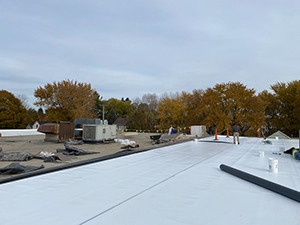
On a single-ply membrane roof, the seams are where systems fail. Every lap between two membrane sheets is a potential failure point if it was not joined correctly. For TPO and PVC membranes, seams are heat-welded using calibrated hot air equipment, creating a fusion bond that becomes part of the membrane itself rather than a separate adhesive joint that can delaminate under thermal stress. When Dallas rooftops are cooking at 150 degrees in July, the seams on an improperly welded membrane are the first things to let go. The equipment settings, travel speed, and technique used during welding directly determine whether the seam will hold across years of North Texas heat cycling. A qualified single-ply contractor knows how to dial their equipment for ambient temperature and membrane temperature conditions on the day of installation, not just run the same settings regardless of conditions.
Membrane Options
A knowledgeable single-ply contractor does not just propose one membrane type for every job. They evaluate the building and make a recommendation based on its specific conditions. TPO is the dominant choice for commercial flat roofs in Dallas because of its white reflective surface, heat-weldable seams, and strong performance-to-value ratio in hot climates. PVC offers superior chemical resistance, making it the better choice for buildings with rooftop grease exhaust, chemical exposure, or restaurant ventilation systems where oils can degrade TPO over time. EPDM is a well-proven rubber membrane that has been installed on commercial buildings for decades and performs reliably in climates where freeze-thaw cycling is a primary concern, though its black surface absorbs more heat than TPO or PVC in a Texas summer. If a contractor proposes the same membrane for every building without asking about your rooftop equipment, building use, or drainage conditions, that is a red flag worth paying attention to.
Pre-Installation Assessment
Before membrane installation begins, a professional single-ply contractor should complete a thorough evaluation of the existing roof assembly. This step is not optional, and skipping it is one of the most common shortcuts that leads to early system failures. Here is what that pre-installation review should cover:
- Core cuts or infrared scanning to locate wet insulation that must be replaced before new material is installed on top of it.
- Deck inspection to confirm structural integrity and identify any areas requiring repair before fasteners or adhesives are applied.
- Drainage evaluation to confirm that the roof slopes adequately toward drains and that drain bowls are clear and functioning.
- Documentation of all penetrations, curbs, walls, and transitions that will require flashing details as part of the new membrane installation.
Expert Single-Ply Roofers
Dallas commercial buildings deserve single-ply roofers who know the work, know the products, and can back their installation with real warranty protection. Anderson Industrial Roofing has been doing exactly that across Dallas, TX since 1993. Call us at 866-949-8016 to schedule a free inspection and find out what your commercial flat roof needs.
FAQ
How long does a single-ply roof installation typically take on a mid-size Dallas commercial building?
Most mid-size commercial single-ply installations complete within three to five days, depending on roof complexity, number of penetrations, and weather conditions.
Does single-ply roofing perform well in Dallas hail events?
Thicker membrane options (60-mil and 80-mil) offer better hail resistance than standard 45-mil membranes, and some manufacturers offer rated hail warranties on qualifying systems.
Can a single-ply membrane be repaired if it is punctured after installation?
Yes, punctures and tears in single-ply membranes can be repaired using compatible membrane patches and the same welding or adhesive methods used during the original installation.
What is the minimum roof slope required for a single-ply membrane system?
Most single-ply manufacturers require a minimum slope of one-quarter inch per foot for proper drainage, though tapered insulation can be used to create slopes on roofs that are effectively flat.