


Choosing a commercial roofing company in Irving, Texas, is easier when every bid is measured against the same written scope. Contractors can quote the same building in very different ways, so the lowest number is not always the best comparison.
Anderson Industrial Roofing is a family owned commercial roofing company that has served building owners since 1993, with more than 30 years of experience, 10,000+ clients and over a billion square feet of roofing installed. This page explains how to compare estimates and what to ask each bidder. To talk through a project, call (866) 949-8016.
What an Irving Commercial Roofing Company Should Put in Writing
A useful estimate describes the work, not just the price. Before comparing totals, confirm that each company has named the roof area, the problem being solved, the proposed system and what is included. Anderson’s commercial roofing solutions describe installation, replacement, commercial roof systems and restoration options, so the first question is which of those services your building actually needs.
If bids describe different services, such as one restoration bid and one replacement bid, they are not competing offers. Ask each company to price the same scope, or to explain in writing why it recommends something different.
Side-by-Side Bid Review Checklist
Use this table to line up estimates from different companies. If a company cannot answer a row, treat the bid as incomplete rather than assuming the item is covered.
| Bid item | What to compare | Why it matters |
|---|---|---|
| Services and scope | Does the bid cover the same work: repair, restoration, replacement or maintenance? | Bids for different work cannot be ranked by price |
| Investigation | Was the roof walked and evaluated, and are moisture and deck conditions addressed in the scope? | A bid priced without investigation may change after work starts |
| System and materials | Which membrane, coating or metal system is named, with thickness and attachment method? | Two bids that both say “flat roof system” may describe very different products |
| Exclusions | What is left out: tear-off, insulation, deck repair, drains, flashing, permits or disposal? | Low totals often leave out items that appear later as change orders |
| Schedule | What are the start window, duration and weather plan? | Tenants and operations depend on predictable timing |
| Occupied property | How will access, noise, debris, equipment and tenant traffic be handled? | Protection for people and interiors should be written down |
| References | Can the contractor provide references for similar commercial roofs? | Recent comparable work says more than a general reputation |
| Warranty responsibility | Who backs the manufacturer warranty and who backs the workmanship, and for how long? | These are separate promises and should be stated separately |
Follow-Up Questions That Reveal Bids You Cannot Compare
- “What is not included?” A clear list of exclusions shows what could become a change order later.
- “What happens if the deck or insulation is wet or damaged?” The answer shows whether repair of hidden damage is priced per unit, included or left open.
- “Which exact product and thickness are you proposing?” Product names let you compare materials instead of marketing terms.
- “How will you protect occupied areas?” The scope should address access, debris, equipment placement and tenant communication.
- “Who handles warranty claims?” Ask for the manufacturer warranty terms and the workmanship terms separately, in writing.
- “What licensing applies to this work, and can I see insurance documentation?” Check any license required for the work and ask for current insurance evidence instead of relying on general claims.
Manufacturer Warranty and Workmanship Responsibility
A manufacturer warranty generally covers the roofing product under the manufacturer’s terms and conditions. Workmanship coverage is a separate promise from the installing contractor about the quality of the installation. A bid that says only “warranty included” does not tell you which one applies, how long it lasts or what voids it. Anderson Industrial Roofing can discuss manufacturer warranty options on new roofing systems for commercial projects, and any warranty details should appear in the written proposal for your specific roof.
How On-Site Estimates Help Make Bids Comparable
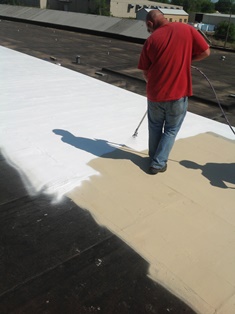
An on-site visit lets a contractor evaluate the roof, identify areas of concern and recommend options for the building. When several companies visit the same roof, ask each to document what was found, such as photos and notes on problem areas, and to tie the proposed work to those findings. Estimates built on the same observations are much easier to compare than estimates built on a phone description.
For an on-site commercial roofing estimate, ask what the roof evaluation will document and how findings will support the written proposal. If the roof is near the end of its service life, review the details of commercial roof replacement so you can compare replacement scopes accurately, and the commercial roofing contractors page for more on how Anderson works with building owners.
Commercial Roofing Estimates in Irving, TX
Anderson Industrial Roofing provides commercial roof evaluations and estimates for Irving and surrounding Dallas-Fort Worth properties. References for past work can be requested, and any claim about experience, services or warranties should be confirmed in the written scope before you sign. To discuss your building, call (866) 949-8016.
Frequently Asked Questions
How many commercial roofing estimates should I get?
Two or three written estimates for the same scope usually give a useful comparison. More bids only help if each one describes the work in comparable detail.
Is the lowest estimate the best choice?
Not automatically. A low total may exclude tear-off, deck repair, flashing or other items that another bid includes, so compare the scope before the price.
What is the difference between a manufacturer warranty and a workmanship warranty?
A manufacturer warranty is issued under the manufacturer’s terms for the roofing product, while workmanship coverage comes from the contractor for the installation. Ask for both in writing.
What should I ask for before signing a roofing contract?
Request the written scope, named materials, exclusions, schedule, occupied-property plan, references and warranty documents, along with applicable licensing and current insurance documentation.