

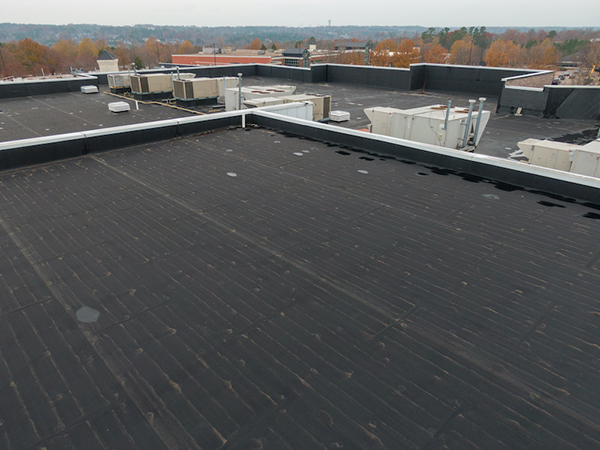
In Garland, a flat commercial roof can go from bone dry to holding an inch of water in under an hour. What happens after that depends almost entirely on the membrane. EPDM roofing has been on Texas commercial buildings for decades, and at Anderson Industrial Roofing we still see original installations shedding water long after newer systems around them were torn off.
Call Anderson Industrial Roofing at (866) 949-8016 for EPDM roofing in Garland, TX.
Standing Water Is the Real Test for EPDM Roofing
Most flat roofs in Garland do not drain perfectly. Slope settles, drains clog, insulation compresses under traffic, and water finds the low spots. EPDM handles that better than almost anything else, and the reason is chemistry.
EPDM is a fully cured synthetic rubber. Curing happens at the factory, before the sheet ever reaches a roof, so the membrane arrives in its final chemical state. Water sitting on it cannot restart or reverse that process. Some membrane types soften, swell, or lose plasticizer when water sits on them for weeks. Cured rubber has no plasticizer to lose.
Ponding is still worth correcting. Standing water adds dead load and hides what is happening underneath. But the membrane is not the part that gives out first, and on a Garland roof that holds water after every storm, that matters.
Membrane Behavior During a DFW Downpour
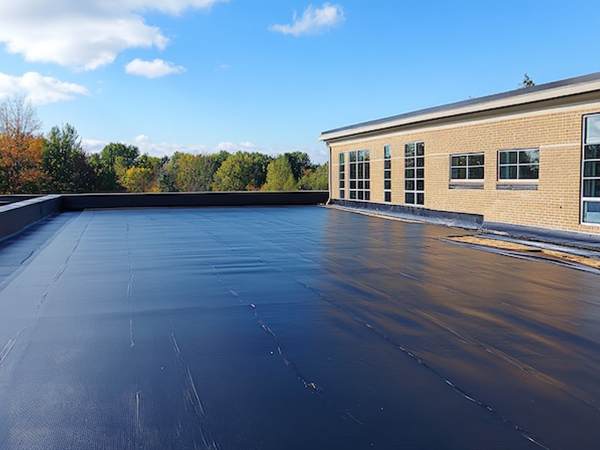
North Texas rain does not arrive gently. One storm cell can drop two inches in ninety minutes while the roof surface swings thirty degrees in temperature.
EPDM stays elastic through all of it. The membrane stretches and relaxes with the deck instead of pulling against it, which keeps it in contact with the substrate while everything underneath is moving. Less flexible components can resist that movement, concentrating stress at corners or curbs.
Elasticity also buys time on small punctures. A dropped tool can puncture any membrane, but rubber tends to close around the damaged area rather than tear outward from it. That can mean the difference between scheduling a repair for next week and finding water in the insulation tonight.
Why EPDM Roofing Seams Matter
A membrane sheet almost never leaks in the field. Leaks happen where two sheets meet.
EPDM laps are joined with adhesive or factory-applied seam tape, and three things determine whether they hold. Lap width comes first: a narrow lap leaves less bonded surface to resist peel. Primer preparation comes second, since a seam rolled over dust will open. Roller pressure comes third, and it is the one most often rushed. Consistent pressure along the full lap is what turns two sheets into one.
When those details are handled correctly, the seam can outlast the sheet. When they are not, membrane quality alone cannot protect the roof.
Thermal Cycling and UV Over the Long Run
Garland roofs live through a wide annual swing. Summer surface temperatures on a dark roof climb well past whatever the air thermometer reads, and January nights drop below freezing.
EPDM expands and contracts through all of that without losing its seal, which is why it keeps showing up on buildings that have already outlived two other roofs. UV exposure is the slower story. Black EPDM absorbs heat and ages gradually at the surface, chalking a little over the years while the body of the membrane stays intact. White EPDM runs cooler and helps with cooling load, though the reflective surface needs cleaning to keep working. They age differently, and a building with heavy air conditioning demand may value the cooler surface more.
What EPDM Roofing Provides a Garland Building
EPDM keeps water out because it stays cured, stays flexible, and seams into a continuous surface when the team takes the laps seriously. Those are unglamorous properties. They are also the ones that decide whether a roof reaches year twenty.
For EPDM roofing in Garland, TX, contact Anderson Industrial Roofing at (866) 949-8016 today.
FAQ
Does ponding water void an EPDM roof warranty in Texas?
Many warranties limit coverage where water stands longer than 48 hours after rain stops, so drainage usually has to be corrected before a claim will be honored.
How often should EPDM seams be checked?
Once a year is enough for most of the roof, though seams near rooftop equipment take more foot traffic and deserve a closer look each visit.
Can an EPDM roof be repaired in cold weather?
Yes, but adhesives and seam tapes have minimum application temperatures, and a repair made below that range usually has to be redone.