


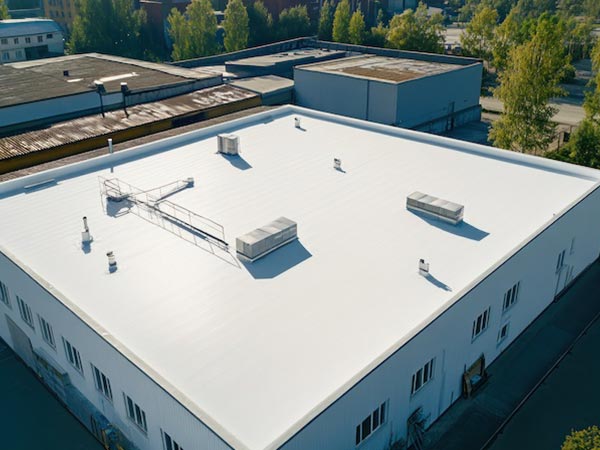
Commercial buildings in Garland put their flat roofs through the full range of Texas weather, and the roof absorbs every bit of it, from triple-digit summer heat to spring hail and heavy fall rain. TPO roofing, a single-ply white thermoplastic membrane welded into one continuous surface, is built to take that range when it is specified and installed for the local climate.
Call Anderson Industrial Roofing at (866) 949-8016 for TPO roofing in Garland, TX.
TPO Roofing vs. North Texas Weather
Garland sits in a climate that swings hard across the year, and a flat roof feels every degree of it. TPO roofing holds up here because each part of that swing tests a different weakness, and the membrane has an answer for each one. The white surface is where it starts.
Through a long North Texas summer, a dark roof absorbs solar heat and pushes rooftop temperatures up, which speeds membrane breakdown and raises the cooling load inside. A white TPO surface reflects much of that radiation instead of soaking it in, so the roof runs cooler and the material ages slower.
Reflectivity is only the summer half of the story. The rest of the year brings different stresses.
TPO Roofing in Texas Winter
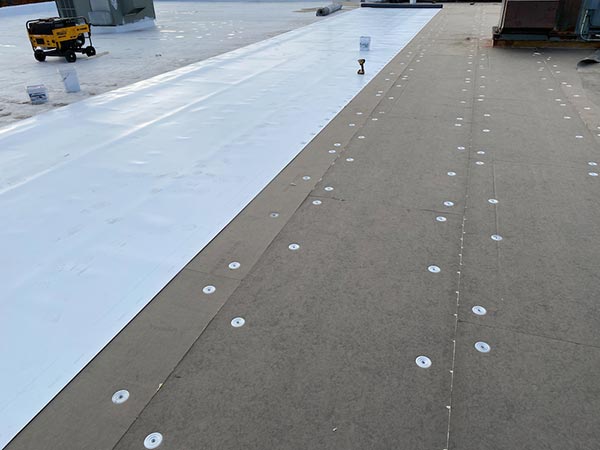
Winter here is mild but unstable. A warm afternoon followed by a hard overnight drop makes the roof expand and contract, a pattern called thermal cycling. Over years, that repeated movement fatigues a membrane and works at its weakest points.
TPO is a thermoplastic, which means it stays slightly flexible and moves with the building instead of turning brittle in the cold. A membrane that flexes through each cycle keeps its seams and its attachment far longer than one that hardens and cracks. In a climate that can freeze at night and thaw by afternoon, that flexibility matters more than the mild winter suggests.
Spring Storms and Hail
Spring is the roughest stretch of the Garland calendar. Hail, straight-line wind, and storm-driven debris tend to arrive in the same few months, and seams are usually the first thing to fail under that load.
TPO seams are joined by heat welding, which melts two sheets into a single bond rather than relying on glue or tape. A properly heat-welded seam can provide a strong, watertight connection so wind struggles to lift an edge and water has no open gap to exploit. Hail can still bruise any membrane, though a well-welded field resists the seam separation that turns one hailstorm into a slow leak.
TPO Roofing Through Heavy DFW Rain
When a DFW storm drops several inches in an hour, the roof has to move that water to the drains without letting any of it reach a seam. This is where continuous welded seams pay off again.
Older or lower-grade systems often leak at seams and laps during heavy rain because those joints were glued, not fused. A properly welded TPO roof gives the water an unbroken surface to run across. Standing water, called ponding, still needs correct slope and drains to clear, though the membrane itself holds.
TPO Roofing Made for Garland Buildings
No single feature makes TPO the right call in Garland. It is the way one membrane answers heat, cold, hail, and rain across a full year. Matching the specification and installation to the local climate turns those advantages into a roof that lasts.
For TPO roofing in Garland, TX, contact Anderson Industrial Roofing at (866) 949-8016 today.
FAQ
How long does a TPO roof usually last in the North Texas climate?
A well-installed TPO roof in the Garland area generally performs for about 20 to 30 years, depending on membrane thickness and upkeep. Thicker membranes and a reflective surface that is kept clean tend to reach the upper end of that range.
Does a white TPO membrane get dirty and lose its reflectiveness?
Over time dirt and airborne grime reduce how much sunlight the surface reflects, especially near vents and rooftop units. A periodic low-pressure cleaning restores much of that reflectivity so the cool-roof benefit continues through the Texas summer.
Can TPO roofing be installed over an existing flat roof in Garland?
In many cases a TPO system can go over a sound existing roof using a cover board, which avoids a full tear-off. That only works when the roof below is dry and structurally solid, so a moisture scan is done first to confirm there is no trapped water.