

Flat roof repair in Wylie, Texas, works best when the repair addresses the actual defect or entry point rather than only the place where water appears inside. Water can travel within a commercial roof or building assembly, so the repair scope should identify the likely source before materials are selected.
Anderson Industrial Roofing is a family owned commercial roofing company that has served building owners since 1993, with more than 30 years of experience. It provides commercial flat roofing services, including leak detection and roof repair, for Dallas-Fort Worth properties such as Wylie. This page explains common flat roof defects, how repairs are matched to the roof system and what a repair scope should include. To discuss a building, call (866) 949-8016.
Common Flat Roof Defects That Repairs Address
Commercial flat roof leaks can involve seams, punctures, flashings, penetrations, drainage, or other details. The table shows common defects, possible repair approaches, and what a written proposal should clarify.
| Defect | Typical repair approach | What to confirm |
|---|---|---|
| Open or separated seams | Use a repair method compatible with the existing membrane and seam construction, which may include resealing, welding, or patching | Repair method matches the membrane, and adjacent seam condition is included in the scope |
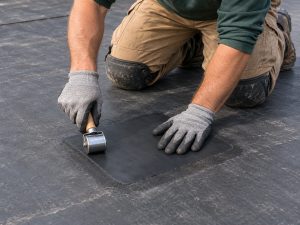
| Punctures and tears | Patch with a material compatible with the existing membrane | Patch extent, preparation, and whether concealed moisture below the defect was evaluated |
| Blisters and wrinkles | Evaluate whether the condition involves air, vapor, moisture, or membrane movement, then determine whether localized repair, monitoring, or a broader scope is appropriate | What evidence supports the cause and whether concealed moisture changes the scope |
| Failed flashings | Repair, re-secure, or replace affected flashing and termination details with compatible materials | Termination, fasteners and the condition of the wall or curb behind it |
| Penetrations | Repair or re-flash affected penetrations and curb details with materials compatible with the roof system | Each penetration is listed, not only the one that leaked |
| Clogged drains and ponding | Clear obstructions where appropriate and evaluate whether recurring standing water is related to outlets, slope, substrate, or another drainage condition | Whether drainage problems are caused by debris, outlet restrictions, slope, substrate movement, or another condition |
Roof access should be handled by trained personnel using appropriate safety procedures because commercial roofs can present fall, access, and surface-damage hazards. From inside the building, occupants can document active water and move contents only when that can be done safely.
Repairs Must Match the Roof System
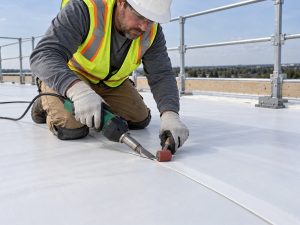
The repair method depends on the existing roof system and the way its seams and details were constructed. TPO, PVC, and EPDM use different compatible repair materials and detailing methods, so the existing membrane should be identified before the repair method is selected. Anderson’s single-ply membrane page describes these systems. Other flat or low-slope assemblies may require different repair materials and detailing, so the scope should be matched to the actual roof rather than a generic patch method.
What a Flat Roof Repair Scope Should Include
- Source investigation: locating where water enters, which may be some distance from the interior stain.
- Moisture assessment: determining whether concealed moisture or deteriorated materials below the defect may change the repair scope.
- Specific repair locations: each repair listed, with photographs before and after.
- Materials: repair materials compatible with the existing roof system.
- Related details: flashings, penetrations, seams, and drains near the leak so adjacent conditions are not ignored.
- Follow-up: any inspection, maintenance, or documentation steps recommended after the repair.
Why Wylie Roofs Need Attention After Storms
North Texas commercial roofs can be exposed to summer heat, heavy rain, wind, and hail. Those conditions can affect membranes, seams, flashings, drainage, and rooftop details. After significant weather, a condition check can document visible changes and help determine whether localized repair or additional evaluation is needed. Keeping drainage paths clear and following an appropriate maintenance plan, such as the ideas in Anderson’s guide to commercial roof maintenance, can reduce avoidable drainage and upkeep problems.
When Repair Is No Longer Enough
Repair can fit when defects are localized and the surrounding roof assembly remains serviceable. If leaks recur in different areas, moisture is widespread, attachment or substrate conditions are deteriorated, or the membrane is failing across broader areas, a larger scope should be compared. In those cases, a compatible restoration coating may be considered only when moisture, adhesion, drainage, substrate, and roof-condition checks support it, or commercial roof replacement may need to be compared. A written assessment should explain why localized repair remains appropriate or why the scope needs to expand.
Flat Roof Repair from Anderson Industrial Roofing
Review Anderson’s commercial roofing solutions or use the commercial roofing estimate page to start a conversation about a Wylie building. You can also call (866) 949-8016.
Frequently Asked Questions
Where do commercial flat roofs usually leak?
Leaks can begin at seams, flashings, penetrations, drains, membrane damage, or other details. Interior stains do not by themselves establish the roof entry point.
Can a flat roof leak be fixed without replacing the roof?
Often, when defects are localized and the surrounding membrane, insulation, attachment, and substrate remain suitable for repair. A written assessment can show whether a larger scope should also be compared.
Why does the repair material matter?
Membranes such as TPO, PVC, and EPDM require repair materials and methods compatible with the existing system. The roof system should be identified before the repair method is selected.
What should I do when I find a leak inside the building?
Document the interior condition and protect contents only when it can be done safely. Roof access and repair should be handled by trained personnel, with the timing based on the severity of the leak and site conditions.