

For commercial property owners in Dallas, TX, energy cost is a constant concern. Long, hot summers and strong sun make the roof a major factor in how hard the HVAC system works. TPO roofing is a reflective single-ply membrane that many owners consider for that reason, but whether it fits a particular building depends on more than its color.
Anderson Industrial Roofing is a family-owned business established in 1993 that installs single-ply roofing systems, including TPO, for commercial and industrial buildings. This article explains how TPO reduces heat gain, where its benefits have limits, and what to check about your own roof before choosing it. To discuss a Dallas building, call (866) 949-8016.
How TPO Roofing Reduces Energy Costs
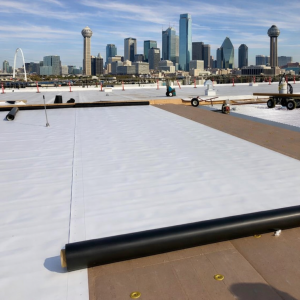
TPO, or thermoplastic polyolefin, is a single-ply membrane commonly used on commercial flat and low-slope roofs. Its white surface reflects a large share of sunlight instead of absorbing it, which helps keep the roof surface cooler than a dark membrane in the same sun.
A cooler roof surface can reduce heat moving into the building during the cooling season, but it does not establish a measured change in utility use. How much that matters depends on the building, so any savings figure should be treated as an estimate until it is checked against the building’s own use.
How TPO Roofing Improves Energy Efficiency
- Reflectivity and heat reduction. The reflective surface reduces solar heat absorbed during Dallas summers. Dirt and weathering can affect reflectance; inspection and any cleaning should follow the membrane manufacturer’s instructions.
- Lower cooling demand. With less heat entering, HVAC equipment may run less during peak hours. The effect may be more relevant to buildings with substantial exposed roof area, depending on insulation and cooling use.
- Indoor comfort. A cooler roof can help stabilize temperatures in large open spaces, though insulation and ventilation also matter.
- Urban heat. Reflective roofs lower rooftop temperatures, although neighborhood-scale effects cannot be calculated from the choice of one roof alone.
Why TPO Roofing Fits Many Dallas Commercial Buildings
Dallas has high temperatures, strong sun and a long cooling season, so reflective roofing earns its attention here. White TPO is one roof option for warehouses, offices, retail centers and industrial facilities, but its suitability also depends on structural, drainage and operating conditions.

It is a good match for some buildings and a poor one for others. Frequent rooftop traffic, grease or chemical exhaust, or drainage limitations may affect membrane compatibility and detailing, which is why the building should be assessed first.
TPO Suitability Matrix for a Commercial Roof
Before choosing TPO, review the roof against the factors below. They also give you the questions to ask any contractor bidding the work.
| Factor | What to check on a Dallas building | Why it affects a TPO decision |
|---|---|---|
| Substrate condition | Deck type, wet or deteriorated insulation, old membrane and flashings | The substrate must support the approved assembly. Confirmed wet insulation and damaged decking need an appropriate corrective scope before installation. |
| Drainage | Slope, ponding, drain and scupper locations and capacity | Persistent ponding calls for drainage assessment and may affect the proposed assembly and warranty eligibility. Drainage fixes may be part of the scope. |
| Attachment | Fully adhered or mechanically fastened as supported by the manufacturer-approved assembly; confirm any proposed alternative | Attachment selection affects wind-uplift design, deck compatibility and roof-system detailing; confirm the approved assembly. |
| Insulation | Existing R-value, thickness and condition, and what code requires on replacement | The membrane reflects heat, but insulation is what slows heat moving through the roof assembly. |
| Rooftop activity | Foot traffic, HVAC service routes, equipment moves, grease or chemical exposure | Heavy traffic may call for walkway protection, and certain chemicals can damage membranes. |
| Detailing | Penetrations, curbs, parapets, edges, expansion joints and transitions | Transitions and penetrations require correctly specified flashing and inspection access. |
| Service access | Roof access, equipment staging, occupied space below and permitted work hours | Access and occupancy shape scheduling, safety planning and noise or odor control. |
Seams, Repairs and Compatibility
TPO sheets are joined at the seams, and the quality of those seams and the details determines how the roof performs. Because a TPO roof will be repaired and changed over its life, compatibility matters as much as installation.
| Topic | What to confirm in writing |
|---|---|
| Seams | TPO field seams are normally joined with hot-air welding. Ask who performs seam checks and how weld quality is verified. |
| Repairs | Repairs to TPO are typically made by welding compatible TPO patches or flashing. Ask what is compatible if the roof is repaired later. |
| Other membranes | TPO should not be assumed compatible with adhesives, sealants or old membranes of a different type. Ask what is allowed in contact with it. |
| Recover over old roof | Ask whether the existing system is dry and suitable, what separator or cover board is used, and how wet areas are found. |
Anderson Industrial Roofing’s single-ply membrane page describes the TPO, PVC and EPDM options it works with. Ask for any seam, repair or attachment detail for your roof in the written scope.
Long-Term Cost Benefits of TPO Roofing
Potential cooling savings are one financial consideration, but should not be assumed to reduce HVAC repairs or roof maintenance. Compare installation details, expected inspections, access needs and the scope of any required drainage or substrate corrections. TPO’s cost compared with other single-ply systems varies by project, so compare written bids for the same scope instead of relying on a general claim. Planned upkeep matters; the commercial roof maintenance guide covers the routine care that protects any roof.
Do not include a rebate or tax benefit in the budget unless a current program has been verified and the selected roof system and building qualify. Confirm eligibility directly with the program administrator before assuming that a Dallas roofing project receives an incentive.
What the Contractor Must Confirm Before Work Starts
- The investigation scope: how the existing roof, insulation and deck will be checked
- The system specification: membrane thickness, insulation, cover board and attachment method
- The detail plan for penetrations, edges, drains and transitions
- How seams will be checked, and who is responsible for repairs afterward
- Exclusions, schedule, protection of the occupied building below and cleanup
- What warranty applies, who issues it and what it covers, in writing
Energy Efficient Roofing Solutions
If cooling performance is a priority, compare a reflective TPO assembly with other eligible systems on the commercial roofing solutions page. Whether you are planning a new installation or commercial roof replacement, a written scope based on your building is the best basis for comparing proposals. For an assessment of the building and roofing scope, call (866) 949-8016.
Frequently Asked Questions
Does TPO roofing qualify for energy rebates in Texas?
It may, depending on the program, the product and the building. Availability changes, so check current local and federal programs before planning around one.
Can TPO be installed over an existing commercial roof?
Sometimes. A recover may be considered only after the existing roof, number of roof layers, deck, moisture conditions, code and manufacturer assembly limits have been assessed.
How does insulation affect a TPO roof’s energy performance?
The reflective surface reduces solar absorption, while insulation controls conductive heat transfer. The design needs a project-specific insulation and code review.
How are TPO seams and repairs handled?
TPO field seams normally use hot-air welding; compatible TPO patches and details may be used for repairs after condition checks. Ask for the seam checks and repair approach in the written scope.