


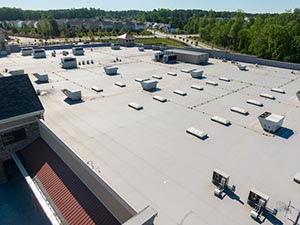
As McKinney continues to add office parks, retail centers, and industrial space, the buildings built sit under a flat roof that must earn its keep. TPO roofing has become the go-to membrane for that type of property, and the reasons stand once you look at what it does for a building owner.
Call Anderson Industrial Roofing at (866) 949-8016 for TPO roofing in McKinney, TX.
What Makes TPO Roofing a Smart Commercial Choice?
TPO stands for thermoplastic polyolefin, a single-ply membrane that rolls out across a flat or low-slope roof in wide sheets. What sells it to building owners is not one feature but the way several of them stack up. The surface reflects heat instead of soaking it in, the seams are welded rather than glued, and the material flexes as the roof moves. Lastly, it tends to last a long time for what it costs to install.
All of these are attributed to a roof that keeps a building cooler, leaks less, and stays out of your repair budget for years. Here is how each piece works on a McKinney commercial property.
TPO Roofing Reflectivity
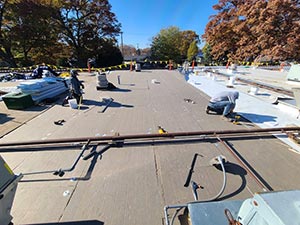
A standard TPO membrane is white, and that color does real work in Texas. A dark roof in McKinney can climb past 160 degrees on a July afternoon, and that heat does not just sit on the surface. It pushes down through the roof assembly and into the building, where your air conditioning must fight it.
A reflective white membrane sends most of that solar energy back into the sky before it ever becomes a cooling problem. For a warehouse or a retail box with a big footprint, which means lower rooftop temperatures and a lighter load on the HVAC system throughout the long Texas cooling season. Building owners who run air conditioning eight or nine months a year feel that difference on every utility cycle.
Welded Seams Make TPO Roofing Stronger
Seams are where most flat roofs fail first. A glued or taped seam relies on an adhesive that breaks down over time, and once it lets go, water finds the gap. TPO does it differently. Adjacent sheets get fused together with hot air, which melts the membrane edges and bonds them into one continuous piece.
Done correctly, that welded seam is stronger than the membrane around it. There is no separate adhesive layer to age out or peel back. On a commercial roof carrying thousands of feet of seam, removing the weakest link from the equation is a large part of why TPO holds up the way it does.
Flexibility and Service Life
The North Texas climate is not easy on a roof. Summer bakes it, then a winter cold snap drops the temperature forty degrees in a day. The membrane must expand and contract through all of it. TPO stays flexible across that range, so it moves with the building instead of cracking under stress.
That flexibility is a big reason a well-installed TPO roof delivers a long service life relative to what it costs. You are not paying a premium up front and you are not replacing it early. For an owner weighing the spending against the years of protection, that balance is the whole argument.
McKinney TPO Roofing Professionals
TPO earns its place on McKinney commercial buildings by doing the unglamorous things well: reflecting heat, sealing tight at the seams, and lasting. When it is specified and installed right, it pays a building owner back season after season. For TPO roofing in McKinney, TX contact Anderson Industrial Roofing at (866) 949-8016 today.
FAQ
Can TPO roofing be installed over an existing flat roof in Texas?
In many cases, yes, if the existing deck is dry and sound, though local code limits how many roof layers a building can carry.
What thickness of TPO is best for a commercial building?
Thicker membranes resist punctures and foot traffic better, so buildings with rooftop equipment access usually benefit from a heavier option.
Does a TPO roof help with a building’s energy rating?
Yes, reflective TPO often qualifies under cool-roof and energy efficiency programs, which can support certain commercial tax considerations.