

Water intrusion is the most common and most costly failure mode in commercial flat roofing, and the quality of work performed by commercial roofers in Fort Worth, TX determines how well a building is protected at every point water can enter. From membrane seams to flashing terminations to rooftop penetrations, the details that keep a commercial roof watertight require skill and precision to execute correctly.
For related commercial roofing guidance in Fort Worth, see commercial roofing contractor in Fort Worth.
Call Anderson Industrial Roofing at (866) 949-8016 for commercial roofers in Fort Worth, TX.
Seams and Flashings: The First Line of Waterproofing Defense
On a commercial flat roof, the membrane seams and flashing details carry more waterproofing responsibility than any other part of the system. A heat-welded seam on a thermoplastic membrane creates a bond that, when executed correctly, is stronger than the surrounding material. An adhesive-bonded EPDM seam, properly primed and pressed, resists water infiltration across its full length. When either type is rushed, under-prepared, or performed without adequate quality control, those seams become the roof’s most vulnerable points rather than its strongest.
Flashings at parapets, curbs, walls, and expansion joints seal the transitions between the membrane field and vertical surfaces, locations where water infiltration is particularly common if details are not executed precisely. Commercial roofers experienced in flat roof systems understand the specific techniques required at each transition type and apply them consistently. Flashing failures that develop years after installation often trace back to shortcuts that were not visible at project completion.
Penetrations and Drainage: Where Commercial Roof Waterproofing Most Often Fails
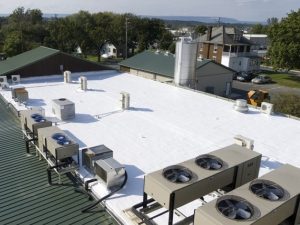
Rooftop penetrations like HVAC equipment bases, pipe boots, conduit entries, and vent stacks are among the most common locations for water intrusion on commercial flat roofs. Each penetration interrupts the continuous membrane field and requires a watertight seal that can accommodate the building’s thermal movement over time. Commercial roofers who understand the mechanics of these details use materials and methods matched to each penetration type, rather than applying a single approach regardless of the conditions at each location.
Drainage components require equal attention. Flat roofs depend on drains, scuppers, and internal gutters to move water off the surface efficiently. A drain not set at the correct elevation relative to the surrounding membrane, or one that lacks an adequate seal where it passes through the roof assembly, creates a recurring source of moisture intrusion that is often misdiagnosed as a membrane failure elsewhere on the roof. Commercial roofers who pay close attention to drainage details at installation prevent many of the leak calls that occur in the years that follow.
Maintaining Waterproofing Performance Over Service Life
Even a correctly installed commercial roof loses waterproofing performance over time without consistent attention. Sealants at penetrations and flashing terminations harden and crack. Membrane surfaces develop erosion that reduces weather resistance. Seams on aging roofs may show early signs of delamination before they develop active leaks. Commercial roofers who provide scheduled maintenance programs identify these conditions while they are still addressable through minor work rather than major repair.
For Fort Worth commercial properties, the region’s climate adds urgency to that consistency. UV intensity through the summer accelerates sealant degradation, spring hail can bruise or puncture membrane surfaces, and thermal cycling across seasons stresses seams and flashing details year after year. Catching sealant failure at a penetration or early seam fatigue before a rain event exposes those weaknesses keeps repair costs lower and prevents the interior water damage that follows when issues go undetected.
Commercial Roofers in Fort Worth, TX
A commercial roof’s ability to keep water out of the building depends on how well it was installed at the detail level, how thoroughly problem areas are identified during service visits, and how consistently the system is maintained between those visits. Each of these is the responsibility of the commercial roofers performing the work. For commercial roofers in Fort Worth, TX contact Anderson Industrial Roofing at (866) 949-8016 today.
FAQ
What are the most common sources of water intrusion on commercial flat roofs in Fort Worth?
Seam failures, flashing gaps at parapet walls and equipment curbs, deteriorated sealants around penetrations, and drainage components that are incorrectly set or clogged are the most frequent sources. Many leaks originate at a transition or penetration point rather than in the open membrane field, which is why those details receive close attention during both installation and subsequent inspections.
How do commercial roofers ensure that penetrations are properly waterproofed?
Experienced commercial roofers select materials and application methods matched to each penetration type and the roofing system it passes through. Proper preparation of the surrounding membrane, appropriate flashing geometry, and compatible sealant selection all contribute to a penetration detail that remains watertight through the building’s thermal movement and Fort Worth’s weather cycles over the years that follow installation.
How often should the waterproofing details on a commercial roof in Fort Worth be inspected?
At minimum twice per year, with additional inspections after significant hail events or severe storms. Flashings, penetration sealants, and seam edges are the highest-priority areas to evaluate, as these are the locations where weathering most commonly results in water infiltration before the problem becomes visible inside the building.