

Single-ply membranes are a common choice for flat and low-slope commercial roofs, but the right membrane depends on the building. For Arlington, Texas, owners, the question is not which membrane has the best headline benefits, but which system fits the roof’s substrate, drainage, attachment options, rooftop activity and detailing.
Anderson Industrial Roofing is a commercial roofing company serving the Dallas-Fort Worth area since 1993. It installs single-ply systems (TPO, PVC and EPDM) across the Dallas-Fort Worth service area, serving the greater Dallas-Fort Worth area, which includes Arlington. This page explains how to assess a membrane system for your building. To discuss a project, call (866) 949-8016, or see the commercial roofing solutions Anderson provides.
Single-Ply Roofers: What They Do
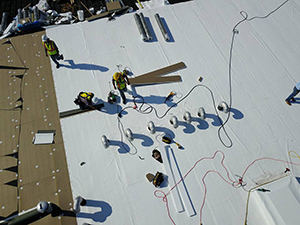
Single-ply roofers install and service membranes such as TPO, PVC and EPDM. A membrane is manufactured in sheets, so a roof is built from rolls that are joined at seams and finished with flashings at walls, curbs, drains and penetrations. Anderson’s single-ply membrane page explains the membrane options. This article is about choosing among them; it is separate from installation and repair details for a specific project.
Understanding the Three Membranes
TPO is a thermoplastic membrane with reflective surface options. PVC is also a thermoplastic with welded seams and is often considered where chemical or grease exposure is a concern. EPDM is a synthetic rubber, usually black, with seams that are sealed with adhesive or tape. None of the three is best for every roof, and performance claims such as longevity, energy savings or wind resistance depend on the product, thickness, installation and maintenance.
Suitability Matrix: Assessing a Membrane for Your Building
Work through these factors before choosing a system. Each one can change which membrane or attachment method is appropriate.
| Factor | What to check | Why it affects the system choice |
|---|---|---|
| Substrate condition | Is the deck sound and is the existing roof dry? Is a tear-off or a recover planned? | Wet insulation or damaged decking requires an appropriate corrective scope before installation |
| Drainage | Where does water leave the roof, and does it pond? | Persistent water calls for drainage assessment, which may identify tapered insulation or drain changes |
| Attachment | Fully adhered, mechanically attached or ballasted? | Ballast adds weight the structure must carry; fastened systems depend on deck type and fastener layout; adhered systems depend on substrate and adhesive |
| Insulation | What insulation and cover board are under the membrane, and is it compatible with the adhesive or fasteners? | Mismatched components can cause blistering, poor adhesion or fastener problems |
| Rooftop activity | How often do crews walk the roof to service equipment? | Heavy traffic calls for walkway protection and a membrane choice that tolerates it |
| Detailing | How many penetrations, curbs, drains and transitions are there? | Flashing and transitions are common points of failure, so the method for each should be specified |
| Service access | How will future repairs and inspections be performed? | Access planning affects maintenance cost and how quickly problems can be found |
Seams, Repairs and Compatibility by System
Seam method matters for both installation and future repairs. A repair has to use materials compatible with the existing membrane.
| Membrane | Seam method | Repair compatibility |
|---|---|---|
| TPO | Heat-welded seams | Repair with a compatible TPO patch and welding; TPO and PVC are not interchangeable |
| PVC | Heat-welded seams (hot air) | Repair with compatible PVC material and welding; check for chemical exposure from exhaust or grease |
| EPDM | Adhesive or tape seams | Repair with materials made for EPDM; seam preparation and cleanliness drive the result |
Ask a contractor to confirm the existing membrane type, the seam method it will use and the repair materials it will specify. For a deeper look at installation choices, review Anderson’s guide to materials and installation methods.
Installation Techniques and Attachment
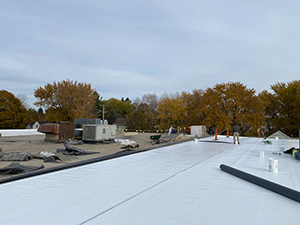
Single-ply membranes are installed fully adhered, mechanically attached or ballasted, and seams are joined by heat welding or adhesive depending on the membrane. Fully adhered systems bond the membrane to the substrate and depend on a clean, compatible surface. Mechanically attached systems use fasteners and plates, which suits many decks and wind conditions when laid out correctly. Ballasted systems are loose-laid and held by stone or pavers, so the structure must carry the extra weight. The attachment method should be named in the proposal.
Durability, Energy Performance and Drainage: Setting Realistic Expectations
Single-ply membranes are designed to flex with temperature changes and resist ultraviolet exposure, and reflective membranes absorb less solar heat than dark ones. How much that affects cooling cost depends on the building, insulation, equipment and maintenance, so savings are not guaranteed. Drainage is a design issue as much as a membrane issue: a smooth membrane does not prevent ponding if the roof lacks slope or functioning drains. Where water stands, discuss tapered insulation or added drains.
Maintenance and Repair
Routine inspections catch small problems such as open seams, damaged flashings and clogged drains before water reaches the interior. Anderson’s commercial roof maintenance guide explains routine care. Repairs depend on the system, as shown in the table above.
What the Contractor Should Confirm in Writing
- The membrane type, product and thickness being proposed.
- The attachment method, and why it fits the deck and structure.
- How seams, flashings, drains and penetrations will be detailed.
- The condition of insulation and decking, and how wet or damaged areas will be handled.
- Manufacturer warranty terms and workmanship terms, stated separately.
- Access and protection plans for occupied buildings.
Single-Ply Roofing in Arlington, TX with Anderson Industrial Roofing
Anderson Industrial Roofing serves commercial properties across the Dallas-Fort Worth area. If a roof needs more than a repair, review commercial roof replacement or start with a commercial roofing estimate. You can also call (866) 949-8016 to talk through your building.
Frequently Asked Questions
What materials are used in single-ply roofing systems?
The most common are TPO, PVC and EPDM membranes. Each has different seam methods, repair requirements and suitability depending on the building.
Why are single-ply systems used on flat roofs?
They are manufactured in sheets and joined at seams, forming a continuous waterproof layer over low-slope roofs. They still depend on drainage, sound substrates and well-made details.
How do I choose between TPO, PVC and EPDM?
Review the substrate, drainage, attachment method, insulation, rooftop activity and detailing for your building, then ask the contractor to explain the recommendation in writing.
Do single-ply roofs require maintenance?
Yes. Routine inspections and prompt repairs help catch seam, flashing and drainage problems early.