


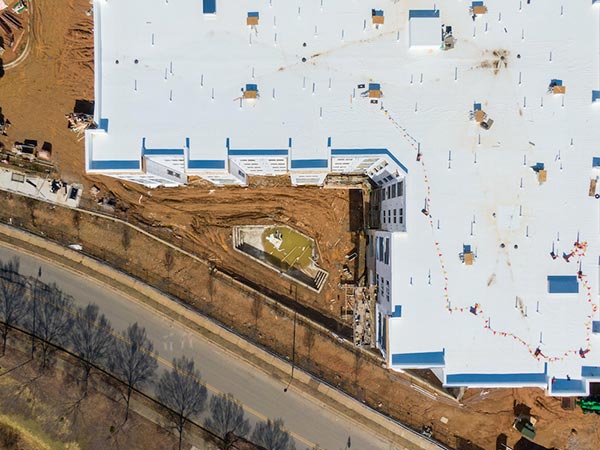
Grand Prairie’s mix of warehouses, distribution centers, and retail buildings puts a lot of flat roof under the Texas sun. If you manage one of those buildings, understanding TPO roofing helps you make a smarter call when it comes time to reroof.
At Anderson Industrial Roofing, we install these systems across the DFW area and can walk you through multiple options for your commercial roof. Call Anderson Industrial Roofing at (866) 949-8016 for TPO Roofing in Grand Prairie, TX.
TPO Roofing Benefits
TPO stands for thermoplastic polyolefin, a single-ply membrane that rolls out in wide sheets across a flat roof. Its surface is usually white, so it reflects sunlight instead of soaking it up. On a hot Grand Prairie afternoon, that reflectivity keeps the roof, and the space under it, cooler.
The other half of the system is the seams. Where two sheets meet, a hot-air welder fuses them into one watertight bond, and that welded seam is far stronger than the glued seams older membranes relied on. It is where TPO earns most of its reputation, and it is also the first thing that separates it from the systems owners tend to compare it against.
How TPO Roofing Differs From EPDM and PVC
EPDM is a black rubber membrane that lasts well but absorbs heat rather than reflecting it. PVC is another welded thermoplastic, close to TPO in behavior, though it adds chemical resistance that suits restaurants and industrial tenants. TPO roofing sits in the middle, pairing reflectivity and welded seams without the higher price PVC carries.
For most Texas commercial buildings, that balance is the whole appeal. You get heat control across a large roof without paying the premium. Where the differences start to matter in practice is in how the membrane is actually fastened to the deck.
Attachment Methods
There are three common ways to secure the membrane. Fully adhered systems glue the sheet straight to the insulation for a smooth, wind-resistant surface. Mechanically attached systems fasten it with plates and screws along the seams, which goes down fast. Ballasted systems hold it in place with stone or pavers.
Which one fits depends on the building’s height, its exposure, and the deck underneath. A tall, wind-exposed roof needs more holding power than a low, sheltered one, so a good roofer weighs uplift and access before committing. That choice, more than the brand of membrane, decides how the roof behaves once the weather turns.
Built for Grand Prairie’s Relentless Heat
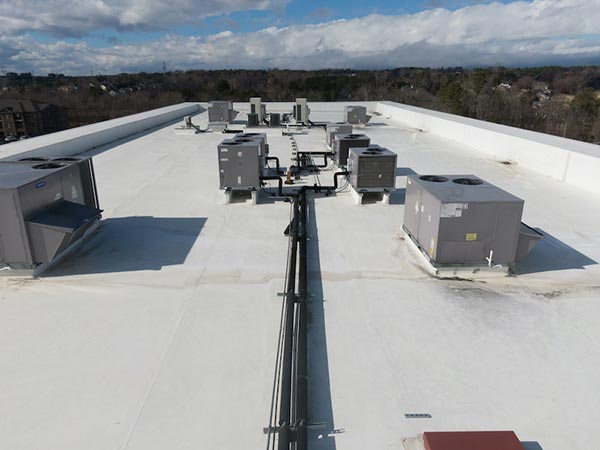
North Texas summers are long, and cooling bills track right along with them. A reflective membrane sends solar heat back up instead of into the building, which takes real load off the rooftop HVAC units. Over the years a roof stays in service, that adds up for a property running air conditioning most of the calendar.
The welded seams matter here too. Because they are fused rather than glued, they hold against the wind-driven rain and hail that move through the DFW area every year. Heat control on one side and storm durability on the other are why the system keeps landing at the top of the list in this market.
TPO Roofing Specialists
Choosing a commercial roof is easier when someone explains the system in plain terms. If you are weighing TPO roofing for a Grand Prairie building, our team can look at your roof and lay out what fits. Anderson Industrial Roofing has installed commercial systems across the region for more than thirty years. For TPO Roofing in Grand Prairie, TX, contact Anderson Industrial Roofing at (866) 949-8016 today.
FAQ
What is TPO roofing made of?
TPO is a single-ply thermoplastic polyolefin membrane. It pairs a reflective top surface with a reinforced core, then bonds to the roof in wide welded sheets.
Is TPO roofing a good choice for hot Texas climates?
Yes. Its reflective surface pushes solar heat away, which helps hold down cooling costs on buildings that run air conditioning through long North Texas summers.
How are TPO roofing seams sealed?
Seams are joined with hot air that melts the edges of two sheets into one continuous bond. That weld is watertight and resists pulling apart over time.